
Grex 2.0 · October–November 2026
Did smaller context make extraction more efficient?
Keeping less reasoning and shorter tool results reduced accepted slots in the matched comparison. The default stayed unchanged.
Completed · policy not adopted
Across six filing families and three slots per arm, full history produced 17 accepted slots out of 18; trimmed history produced 13 out of 18. The trimmed arm accumulated six deadline-exhausted attempts and two outputs with critical regressions. The policy was not adopted as the default.
The experiment, explained
A narrated explanation of recorded results, with synthetic narration and visible English captions. Diagrams explain the method; they are not recordings of execution.
Read the video transcript
Can smaller context help?
After the first extraction study, we tested whether keeping less worker history could improve efficiency without reducing quality. This was a separate comparison, with a revised extraction contract.
Two history policies
One arm kept its full history. The other retained recent reasoning and shortened tool results. Both used the same worker model and the same six document families.
Eighteen slots per arm
Each family received three slots per arm. The evaluator scored anonymous artifacts before learning their source. Slots and execution attempts were counted separately because some attempts needed replacement.
The trimmed arm fell behind
Full history produced seventeen accepted slots out of eighteen. Trimmed history produced thirteen. The trimmed arm accumulated six deadline failures and two outputs with critical regressions.
Keep failed attempts visible
Eight quota interruptions were excluded under the infrastructure rule. Deadline failures remained visible. Looking only at completed artifacts would make the trimmed policy appear more reliable than it was.
No default change
We kept full history as the default. A later worker pool run used different conditions and stays separate. Neither result establishes sustained throughput or lower total operating cost.
What were we trying to find out?
Does trimming a coding worker’s history preserve extraction quality while improving execution efficiency?
Hypothesis
Keeping recent reasoning and capped tool results might reduce repeated context without harming extraction outcomes.
Reconstructed from the recorded context-efficiency change and comparison, not a registered numerical effect prediction. An earlier version did not exercise the intended pruning behavior and is not pooled with this test.
How the experiment worked
Compare the same worker model on six filing families with full history versus a bounded-history policy. Score anonymized artifacts before revealing their arm.
Full history
- Keep reasoning and tool history
- 18 non-quota attempts
Trimmed history
- Recent reasoning + capped results
- 21 non-quota attempts
Final accepted slots: full 17/18 · trimmed 13/18
8 quota interruptions excluded; deadlines remain failures; retries are not extra slots.
Download the method illustration
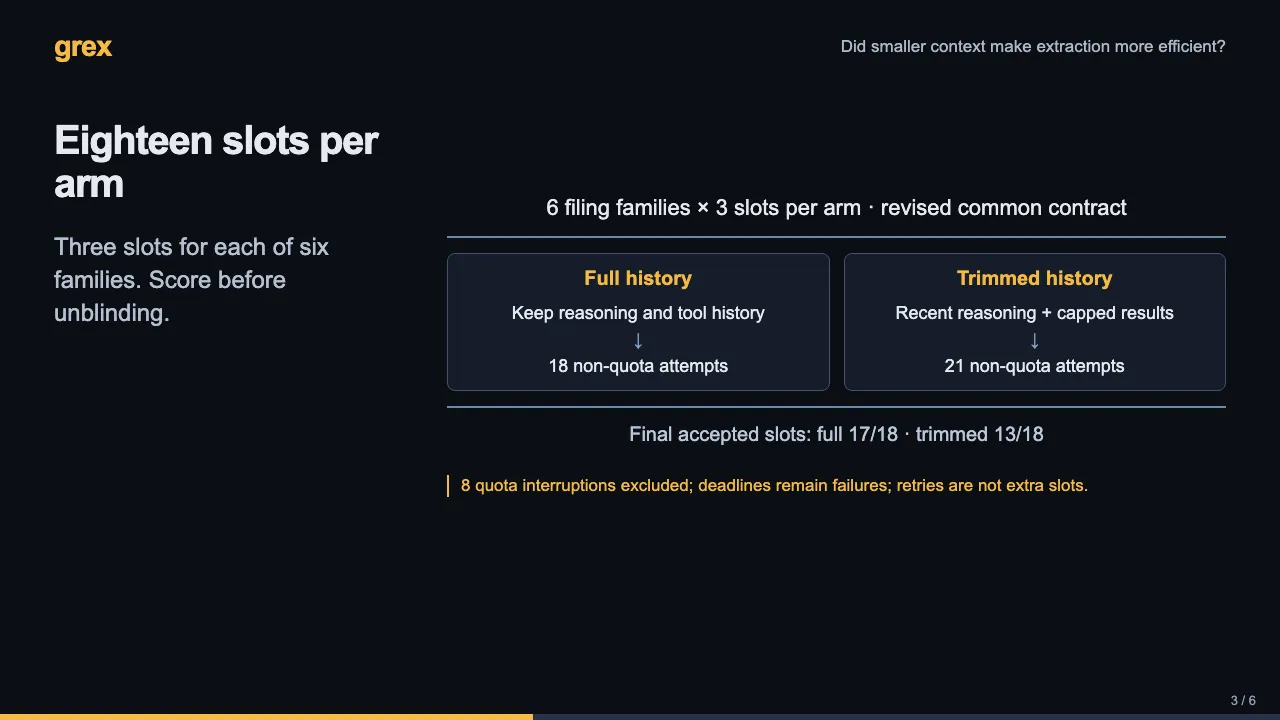
Sample: Six families × three planned slots per arm: 18 slots per arm. Replacement attempts and provider interruptions are additional execution events, not additional scored slots.
Pin the revised extraction contract
Use the later reference and contract that allow unstated exhibit formats; do not pool these scores with the initial study.
Vary history handling
Keep full history in one arm. In the other, retain reasoning from two recent turns and cap tool results at 6,000 characters, or 2,000 for failed output.
Record every attempt
Apply the infrastructure replacement rule to quota interruptions and retain retries and deadline failures in the ledger.
Score before unblinding
Evaluate anonymous outputs, then map final slot outcomes back to the two history policies.
Controls and differences
- Both arms used MiniMax-M3 on the same worker host and the same revised extraction contract.
- The evaluator scored anonymous artifacts before arm identities were revealed.
- Eight quota interruptions in the trimmed arm were excluded under the infrastructure-replacement rule. Deadline handling required clarification; replacements made attempt counts unequal.
What happened
| Measure | Full history | Trimmed history |
|---|---|---|
| Final evaluator-accepted slots | 17 / 18 | 13 / 18 |
| Non-quota attempts, including replacements | 18 | 21 |
| Deadline-exhausted attempts | 0 | 6 |
| Outputs with critical regressions | 1 | 2 |
| Excluded quota interruptions | 0 | 8 |
Less history did not improve this result
Full history finished with 17 accepted slots; trimmed history finished with 13. The latter required more attempts and experienced six deadline exhaustions.
Attempts and slots are different denominators
The trimmed arm had 21 non-quota attempts for 18 slots, plus eight excluded quota interruptions. A score based only on successfully produced artifacts would hide failures.
The conclusion survives the timeout sensitivity
A deadline-excluding sensitivity view gave trimmed history 13 accepted slots out of 15 versus full history 17 out of 18. It still did not demonstrate an advantage.
A later pool run asked a different question
A separate twelve-mission snapshot on November 2 using two configured worker routes finished in fourteen minutes: twelve validator passes, eleven evaluator acceptances and seven reviewer acceptances. Model and family assignment were confounded. Those results are not part of this history-policy comparison.
What this does not establish
- Six families with repeated slots are a narrow sample, not eighteen independent document types.
- Quota interruptions and replacement attempts affected the trimmed arm. Timing summaries over unequal attempt sets are not a clean speed comparison.
- An earlier policy version did not trigger its intended pruning; it cannot be counted as evidence that trimming works.
- Mechanical validation, evaluator acceptance and reviewer acceptance measured different properties. The later pool run did not establish model superiority or sustained throughput.
- No complete all-in cost comparison or reduced operator-effort result was established.
The decision
Leave the original full-history coder as the default. Retain the negative result instead of presenting context reduction as an efficiency win.
What followed
This comparison is complete. The separate pool run is limited follow-up evidence, not a successful replication of the context policy or a scheduled scaling commitment.
Evidence and further reading
Public summaries retain the reported counts and limitations. Private execution traces and infrastructure details are not published.
- Download the evidence summary
Sanitized aggregate transcription of retained study reports and final closeout evidence. This is not a raw-data release or independent reproduction.