
Grex 2.0 · October 2026
Research that never reached review
Three rounds exposed execution and output-contract failures before research quality could be judged.
Closed · quality target missed; no briefs reviewed
Across three rounds, nine worker executions produced no reviewable brief. Two further launches failed before worker execution, and four planned slots were not launched. No independent research review or correction ran.
The experiment, explained
A narrated explanation of recorded results, with synthetic narration and visible English captions. Diagrams explain the method; they are not recordings of execution.
Read the video transcript
No brief reached review
Grex runs AI assignments and keeps their evidence. This research experiment asked whether at least four of five tasks could reach acceptance with no more than one correction.
A five-task panel
The plan used MiniMax to gather sources and write a structured brief. A separate Claude reviewer would judge the result. Every launched assignment allowed one automatic correction.
The test changed
The team repeated the panel across three rounds while changing platform builds and input limits. These repetitions diagnosed failures. They were not independent trials under identical conditions.
Zero reviewed
Nine worker executions produced no reviewable brief. Two more launches failed before the worker started, and four planned slots were never launched. No independent review or correction ran.
An unanswered question
Some outputs violated the brief schema. Others hit execution bounds. These failures explain why delivery stopped, but they do not establish that a reviewer judged the research inaccurate.
Repair before claiming
The decision was to repair execution and output contracts before claiming research quality. Later successes need separate evidence. They cannot erase what happened in this historical experiment.
What were we trying to find out?
Could Grex deliver accepted research briefs for at least four of five planned tasks, with no more than one correction per task?
Hypothesis
At least four of five research task lineages would reach acceptance within one correction. A lineage includes the original attempt and any allowed correction.
The four-of-five target and one-correction limit were recorded in the original measurement protocol. This wording restates that target; it is not a newly registered hypothesis.
How the experiment worked
The experiment reused a five-task research panel across three rounds. MiniMax was configured to gather and synthesize evidence, with a separate Claude reviewer and one automatic correction allowed. Execution failures prevented that review stage from starting.
Executed
- Nine worker executions
- Bounds or schema failure
- No reviewable brief
Blocked slots
- Two pre-worker failures
- Four slots never launched
Independent review: zero briefs · review-driven correction: zero runs
The experiment failed to deliver the artifact needed to measure research quality.
Download the method illustration
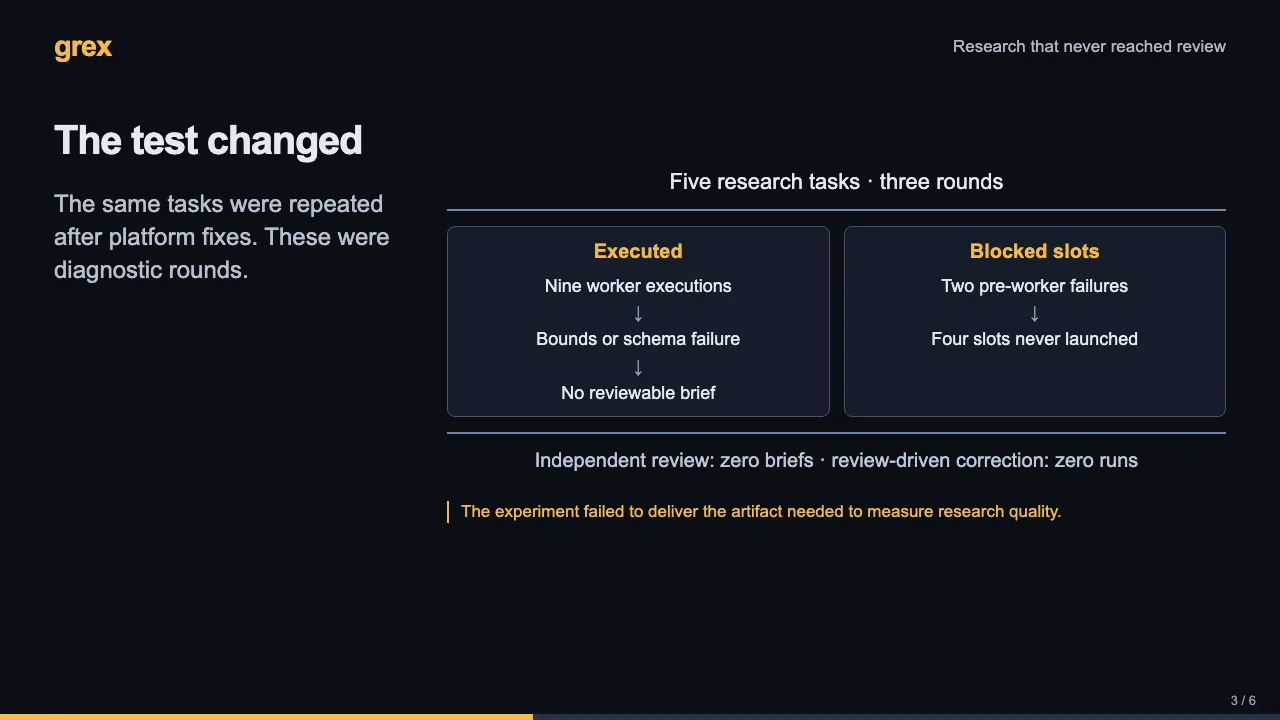
Sample: Five planned task slots in each of three rounds: nine worker executions, two pre-worker failures and four unlaunched slots.
Set the acceptance target
Require four of five task lineages to be accepted within at most one correction.
Run bounded research
Ask MiniMax to fetch sources, extract claims and produce a structured research brief within recorded input, output and tool limits.
Repeat after platform fixes
Run the panel again after two platform changes. The request-size allowance also changed, so the rounds are diagnostic repetitions rather than fixed-condition replicates.
Inspect where work stopped
Retain execution dispositions, transcripts and absent outputs. Check whether a valid brief reached independent review before attributing failure to research quality.
Controls and differences
- The same task specifications were reused across rounds.
- One correction was configured for every launch, but none ran.
- The worker route, platform build and bounds are part of the conditions; the platform changed between rounds.
- Recorded operator-time inputs were estimates, not a timed direct-agent control. No labor-saving comparison is claimed.
What happened
| Measure | Observed |
|---|---|
| Accepted / reviewed briefs | 0 / 0 |
| Worker executions | 9 across three rounds |
| Failures before worker execution | 2 |
| Planned slots not launched | 4 |
| Review-driven corrections | 0 |
The quality question remained unanswered
Every execution stopped before independent review. There were no completed brief artifacts and no research evidence checks. Zero acceptances therefore cannot be interpreted as nine reviewer judgments that the research was poor.
Output contracts blocked delivery
Some outputs exceeded the total synthesis length or used quote anchors shorter than the schema allowed. An internal critic returned edits, but its output still failed the schema. That internal phase was not the independent reviewer or the configured correction loop.
Runtime failures reduced the panel
Other attempts hit tool, request-size or completion-token limits. A Windows launch failure and a stale process marker prevented two worker starts; four planned slots were left unlaunched.
What this does not establish
- This measured one historical build sequence, not current Grex research reliability.
- No valid brief reached independent review, so research accuracy and reviewer effectiveness were not measured.
- Repeated tasks and changing builds prevent treating these rounds as an independent controlled comparison.
The decision
Record the missed target and repair execution and output contracts before claiming research quality or correction effectiveness.
What followed
The failure record identified contradictory synthesis limits, unhelpful schema errors and runtime cleanup problems. Later research runs require their own evidence; they do not change this attempt’s outcome.
Evidence and further reading
Public summaries retain the reported counts and limitations. Private execution traces and infrastructure details are not published.
- Sanitized measurement summary
Transcribed from the retained October 22 measurement report and reconciled mission identities. Private transcripts and machine details are omitted.