
Historical Grex 1 · August 2026
Could Grex find conversations worth joining?
Social-discovery calibration exposed selection and review failures; the planned Hermes comparison never produced a scored result.
Calibration only · comparison held
The retained evidence covers Grex-side calibration, not the planned seven-pair comparison. Repeated searches rediscovered unsuitable posts, and one published internal brief contained refusal text as its suggested reply. A separate reviewer then judged that brief not worth reading. No Grex-versus-Hermes precision result was established.
The experiment, explained
A narrated explanation of recorded results, with synthetic narration and visible English captions. Diagrams explain the method; they are not recordings of execution.
Read the video transcript
Find a conversation worth joining
Could Grex find conversations worth joining and draft useful replies? The experiment proposed comparing it with Hermes using the same model, through controlled and field tracks.
A hypothesis registered in advance
This study did record a directional hypothesis and numerical pass conditions before scored runs. It expected better recommendation precision and reply usability. Calibration was explicitly excluded from that formal test.
What actually ran
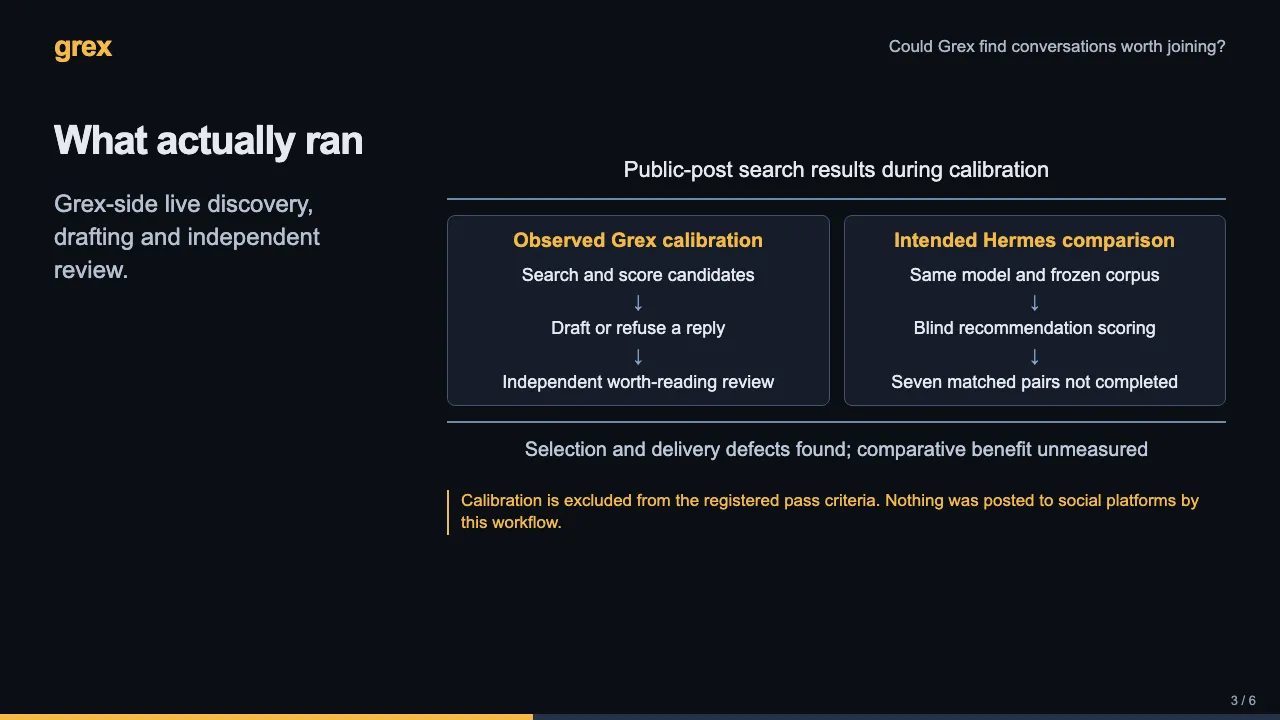
The retained evidence shows Grex-side calibration. Searches fed relevance scoring and drafting, followed by a separate reviewer. The intended seven matched comparison pairs did not produce a completed scored result.
Activity was not progress
Three slots rediscovered the same fifty-three candidates. Eight repeatedly reached drafting and were refused. A later brief mistakenly carried refusal text as its reply; independent review found it not worth reading.
Source validity is not usefulness
The source and evidence link could be checked, yet the recommendation was still unhelpful. These calibration observations cannot establish comparative precision, engagement uplift, customer demand or the cost of useful recommendations.
Keep the unanswered question visible
We retain the selection and delivery failures without inventing a winner. A resumed comparison would need fresh bounded conditions and honest failure accounting. This historical record does not imply a restart.
What were we trying to find out?
Could Grex find useful public conversations and draft evidence-supported replies more effectively than Hermes using the same underlying model?
Hypothesis
Grex’s task boundaries, evidence checks and separate reviewer would improve recommendation precision and reply usability over an unaided Hermes session at acceptable review effort.
Paraphrase of the original hypothesis recorded before scored runs in the August 29 experiment charter. Unlike the other retrospective summaries, this study did register directional and numerical pass conditions. Calibration did not test those conditions.
How the experiment worked
The charter proposed a controlled track with the same frozen candidate corpus for both arms and a separate field track using each arm’s native tools. Actual retained calibration exercised Grex’s live search, filtering, drafting and separate review path.
Observed Grex calibration
- Search and score candidates
- Draft or refuse a reply
- Independent worth-reading review
Intended Hermes comparison
- Same model and frozen corpus
- Blind recommendation scoring
- Seven matched pairs not completed
Selection and delivery defects found; comparative benefit unmeasured
Calibration is excluded from the registered pass criteria. Nothing was posted to social platforms by this workflow.
Download the method illustration
Sample: Calibration observations from August 29–30, including three repeated search slots and the first reviewed brief. They are not seven scored pairs or independent discovery samples.
Define the intended comparison
Register a shared-model question, frozen-corpus track and blind recommendation rubric.
Calibrate live discovery
Search public posts and observe which candidates reach drafting.
Check the proposed reply
Retain refusals and distinguish actual replies from commentary refusing to engage.
Review separately
Re-fetch evidence and use a separate model context to judge whether a brief is worth reading.
Controls and differences
- The proposed formal comparison required the same resolved MiniMax model, alternating order and blind scoring. Those are planned controls, not evidence that a scored comparison ran.
- Calibration was explicitly excluded from the registered pass/fail calculation.
- The live reviewer used the same model as drafting in a separate process and context, after deterministic source checks.
- The tested workflow had no tool to post replies externally. Internal brief publication was not social-platform publication.
- The registered bar required at least 70% recommendation precision and a 20-percentage-point lead over Hermes, zero unsupported material claims, at least half the replies usable with light editing, and review under 15 minutes. These thresholds were not scored.
What happened
| Measure | Planned comparison | Observed calibration |
|---|---|---|
| Matched scored runs | 7 pairs | No completed paired result recorded |
| Repeated search slots | Independent scored recommendations | 53 candidates in each of 3 slots |
| Candidates sent to drafting per slot | Up to 5 final recommendations | 8 candidates; all 8 refused |
| First reviewed internal brief | Worth-reading assessment | Rejected as not worth reading |
| Public replies | Separate publication decision | No posting path in the tested workflow |
Repeated search was not fresh progress
Three recorded slots each rediscovered the same 53 candidates. Eight reached drafting each time and all eight were refused as promotional or otherwise unsuitable. The workflow spent effort repeating a decision instead of learning from it.
A refusal became a suggested reply
A later internal brief carried the drafter’s refusal as if it were a reply. This was a delivery defect: text existed, but it did not satisfy the intended engagement task.
Independent review contradicted the relevance score
The first live reviewer verdict found the post resolvable and its evidence link present, yet judged it not worth reading. Mechanical source validity and keyword relevance did not establish usefulness.
The comparison question remained unanswered
The formal results table was never filled with seven scored pairs in the records reviewed. Calibration exposed useful defects, but it did not establish better precision, lower review effort or improved audience response versus Hermes.
What this does not establish
- Historical architecture and calibration only, not a current Grex social-integration capability.
- The observed slots reused candidates and involved operational adjustments. They are not independent trials or a controlled quality estimate.
- The intended controlled and field tracks differed in source and tool treatment; neither supplies a completed comparative result here.
- Registered precision, reply-usability and review-time thresholds were not evaluated by these calibration observations.
- No customer demand, revenue, engagement uplift or complete cost-per-useful-recommendation result was established.
The decision
Retain calibration findings while leaving the formal comparison unresolved. A working search-to-review pipeline and a single rejection are not evidence that Grex outperforms Hermes.
What followed
Any resumed comparison would need a fresh bounded plan, distinguish controlled-corpus work from live discovery, and keep failed or unhelpful outputs visible. No restart is implied by this historical record.
Evidence and further reading
Public summaries retain the reported counts and limitations. Private execution traces and infrastructure details are not published.
- Download the sanitized evidence summary
Aggregate transcription of retained historical source records. Not a raw-data release or independently reproduced experiment.